Tag Archives: veterans

On writing—and war stories we want to read

Redepolyment & The Bosnia ListToday, some words of wisdom from wonderful writer and former U.S. Marine Phil Klay, author of the acclaimed new short story collection Redeployment.

“When I came back I had all these questions to think about that were interesting or important for me, and writing the book was one way for me to grapple with both what the experience meant to me and what the war in Iraq meant to our country and culture.”

        – Phil Klay, author of Redeployment

*interviewed by Kirkus Reviews (Megan Labrise)

Redeployment powerfully encompasses multiple perspectives and experiences of war. The collection recently received a fabulous review (an engaging read in itself, while informative about the qualities that recommend the review’s subject), by Dexter Filkins, author of The Forever War, in the New York Times Book Review.

~  ~  ~

In April, The Center for Fiction, in midtown Manhattan, near Grand Central, hosts Phil Klay on Redeployment and Jennifer Vanderbes, whose new book The Secret of Raven Point, is about a brother and sister, soldier and nurse, stationed in Europe during World War II.

That’s April 10th at 7:00 p.m. in NYC.

~ ~ ~

War literature is also coming up at Franklin Park’s Reading Series. You can catch Jennifer Percy, author of Demon Camp, about a returning Afghanistan veteran, along with Kenan Trebincevic and Susan Shapiro, writing about Trebincevic’s experiences as a Bosnian émigré and his trip back after the war in The Bosnia List, plus Liza Monroy, author of The Marriage Act, and essayist Melynda Fuller.

That’s this coming Monday, March 24th at 8:00pmFranklin Park Bar and Beer Garden.

~~~~~

** A huge THANK YOU to Poets & Writers and The New York State Council on the Arts for supporting another season of Voices from War, A Writing Workshop for Veterans. And an ongoing THANK YOU to the 14th Street Y, supporter and sponsor, welcoming the workshop and its participants each week; and building Voices from War. **
~~~~~~~~~~

Start telling your story.

______________
Voices from War’s Writing Workshop for Veterans – Winter-Spring 2014 is running now.
Stay tuned for summer options.
Come work on your story in a supportive community of fellow vets.
Space Limited.
Next Class (#6 of Season 2): March 23rd.
__________

A decade of war—stories shape history

Who should tell us about the experiences of a decade of war? Veteran voices need to be part of the national dialogue, cultural and literary, on what it means to go to war; reminding all of us of the multiple perspectives, complex feelings and experiences of serving and fighting.

History is shaped by the accounts that emerge in the living years following historic events, including events we may perceive as less ‘historic’—individual accounts of departing, serving, waiting (whether a spouse back home or a soldier waiting for deployment), and return.

Stories—whether true accounts in the form of essays or memoir, or fictional narratives born of lived truths—shape how all of us see, how we remember. Stories create bridges of understanding, among veterans and between veterans and civilians.

“The autumn countryside around them felt gloomy and forlorn at this hour. The train which was to take both Masha and Ivanov to their homes was somewhere far off in grey space. There was nothing to divert or comfort a human heart except another human heart.”

        – Andrey Platonov, “The Return” *

From the past, we learn about the present; and from the present we inform the future.

~~~

 *"The Return," by Andrey Platonov, from The Return and Other Stories, by Andrey Platonov, transl. by Robert and Elizabeth Chandler and Angela Livingstone; reprinted in Let's Call the Whole Thing Off: Love Quarrels from Anton Chekhov to ZZ Packer, selected by Kasia Boddy, Ali Smith, and Sarah Wood, © 2009.

~~~~~

** A huge THANK YOU to Poets & Writers and The New York State Council on the Arts for supporting another season of Voices from War, A Writing Workshop for Veterans. And an ongoing THANK YOU to the 14th Street Y, supporter and sponsor, welcoming the workshop and its participants each week; and building Voices from War. **

~~~~~~~~~~

Start telling your story.

______________
REGISTRATION open for Voices from War’s Writing Workshop for Veterans – Winter-Spring 2014.
Come work on your story in a supportive community of fellow vets.
Space Limited.
Next Class (#3 of Season 2): Feb. 23rd.
__________

Telling a true story—through facts or fiction

Writing things down, telling a true story or turning it into fiction, helps us make sense of complex or fragmented memories and experiences. By looking back, writers are moving forward. Sharing experiences opens up possibilities for dialogue, between individuals and more broadly, in communities and nationally.

Whether we write for ourselves, our friends and family, or with the intent of reaching a wider audience, putting words on paper matters. We are communicating; we are building community; we are acknowledging the past and building the future.

“From the events of war he had wrested the lonely elements of maturity. He wanted, now, discoveries to which he sensed himself accessible; that would alter him, as one is altered, involuntarily, by a great work of art or an effusion of silent knowledge.”

        – Shirley Hazzard

From The Great Fire, by Shirley Hazzard, ©2003

~~~~~~~~~~

Start telling your story.

______________

OPEN HOUSE— SUNDAY, JANUARY 26th—NYC
4:00-6:00pm
RSVP – info@voicesfromwar.org
344 East 14th Street, NYC
__________
REGISTRATION open for Voices from War’s Writing Workshop for Veterans – Winter-Spring 2014.
Come work on your story in a supportive community of fellow vets.
__________

Writing about war—history became personal

Historian and World War II veteran William Manchester writes about the urge to revisit his own memories of service during World War II, after working and writing as a historian of the era for years:

“The dreams started after I flung my pistol into the Connecticut River. It was mine to fling: I was, I suppose, the only World War II Marine who had had to buy his own weapon.”
“For years I had been trying to write about the war, always in vain. It lay too deep; I couldn’t reach it. But I had known it must be there. A man is all the people he has been. …[L]ike most of my countrymen, I am prone to search for meaning in the unconsummated past.”
“…I couldn’t define what I sought….”

– William Manchester

From Goodbye, Darkness: A Memoir of the Pacific War, ©1979

~~~~~~~~~~

What’s your story?

__________
REGISTRATION open for Voices from War’s Writing Workshop for Veterans – Winter-Spring 2014.
Come work on your story in a supportive community of fellow vets.
__________

Don’t miss…

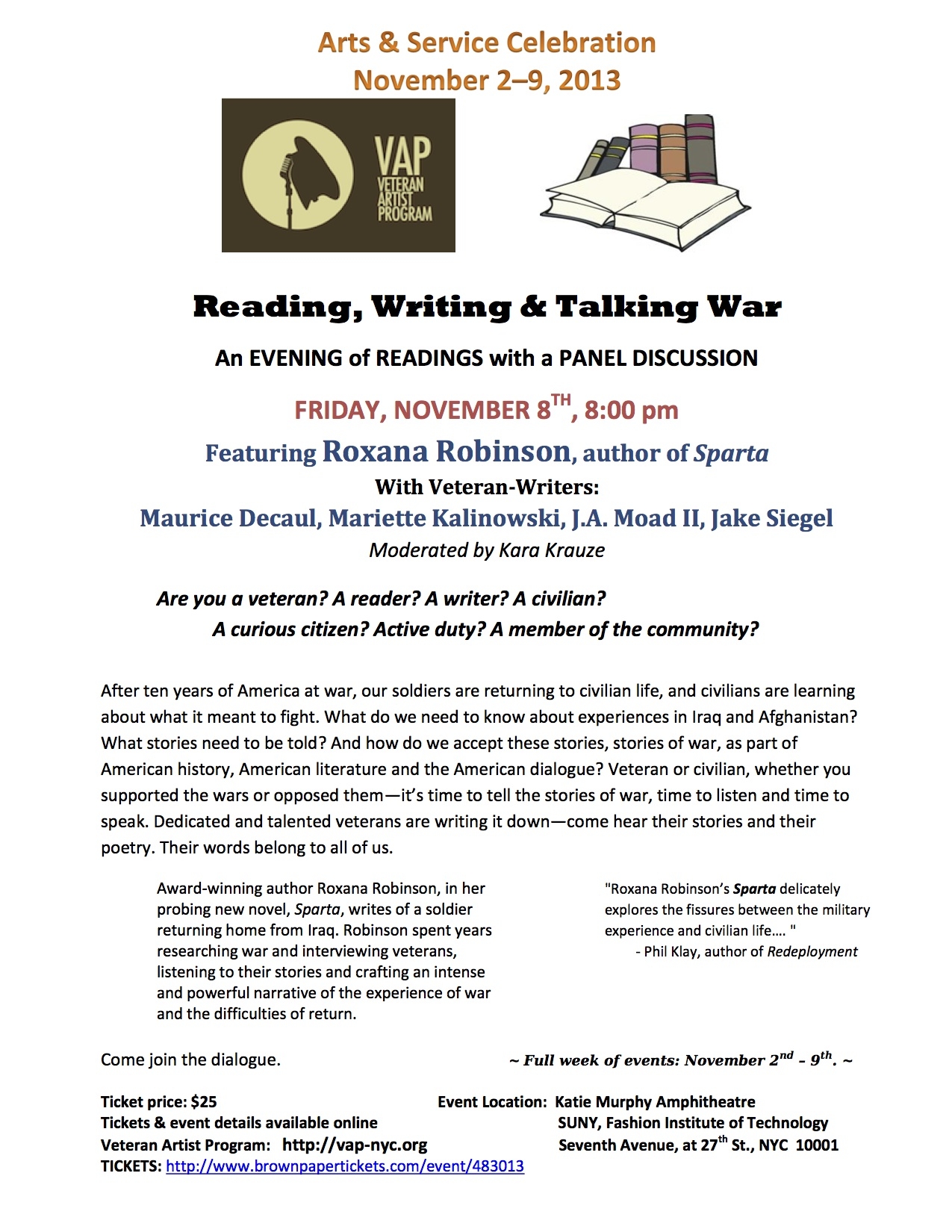
Reading, Writing & Talking War
on November 8th

Scaled ticketing available: $10, $15, $25 (open seating).
Block comp tickets available for veterans and students, and reserved comp tickets on request.
For any complimentary ticketing, please contact…

jordan@veteranartistprogram.org

Facebook Event page

Flyer__READING_WRITING_and_TALKING_WAR_Nov_8_2013 _picREADING, WRITING & TALKING WAR

For other exciting events the week of November 2nd – 9th…visit the Veteran Artist Program at http://vap-nyc.org

Don’t miss the stories. Don’t miss the dialogue.

If you are a veteran, and want to work on your own stories…

REGISTRATION open for Voices from War’s Writing Workshop for Veterans.
Come work on your story in a supportive community of fellow vets.
__________

A poem with a story of war—and after

Today, a poem from Israeli poet Yehuda Amichai (1924-2000), which encapsulates transitions from childhood to war to the pain of after, ending on a note of possibility:

Autobiography, 1952

  • My father built over me a worry big as a shipyard
  • and I left it once, before I was finished,
  • and he remained there with his big, empty worry.
  • and my mother was like a tree on the shore
  • between her arms that stretched out toward me.
  •  
  • And in ’31 my hands were joyous and small
  • and in ’41 they learned to use a gun
  • and when I first fell in love
  • my thoughts were like a bunch of colored balloons
  • and the girl’s white hand held them all
  • by a thin string—then let them fly away.
  •  
  • And in ’51 the motion of my life
  • was like the motion of many slaves chained to a ship,
  • and my father’s face like the headlight on the front of a train
  • growing smaller and smaller in the distance,
  • and my mother closed all the many clouds inside her brown closet,
  • and as I walked up my street
  • the twentieth century was the blood in my veins,
  •  blood that wanted to get out in many wars
  • and through many openings,
  • that’s why it knocks against my head from the inside
  • and reaches my heart in angry waves.
  •  
  • But now, in the spring of ’52, I see
  • that more birds have returned than left last winter.
  • And I walk back down the hill to my house.
  • And in my room: the woman, whose body is heavy
  • and filled with time.

Yehuda Amichai

From The Selected Poetry of Yehuda Amichai, ©1986, 1996

Translated by Chana Bloch and Stephen Mitchell

What’s your story?

__________
REGISTRATION open for Voices from War’s Writing Workshop for Veterans – Fall 2013.
Come work on your story in a supportive community of fellow vets.
__________

War and music and poetry—Iraq veteran Maurice Decaul

Poet and veteran Maurice Decaul is partnered up with musicians Vijay Iyer and Mike Ladd for their new album, Holding It Down, which received four (of four) stars in the LA Times last week. Critic Chris Barton writes,

“An exposed nerve on the edge of madness, ‘Shush’ may be one of the most haunting songs of the year. With Decaul repeating, like a mantra, ‘I’ve been talking in my sleep again,’ he conjures muzzle flashes, burning diesel and ‘sandbag eyes, large like dish plates, scared.’ As Iyer’s flickering piano hurtles behind him, Decaul builds to a matter-of-fact admission so raw it burns: ‘I prayed to die in Iraq.'”

Barton writes on the possibilities of music and the album’s combination of jazz, hip-hop, and oral history:

“At their best, hip-hop and jazz remain most adept at breaking the mold, and the footprints of both genres can be heard on Vijay Iyer’s and Mike Ladd’s inspiring new album. An ambitious collaboration between one of the most celebrated jazz pianists today in Iyer and poet-MC Ladd, who has worked with a host of underground rap acts including El-P’s Company Flow and Saul Williams, ‘Holding It Down’ is the duo’s third in a series of unclassifiable blends of music, theater and spoken word that paint a vivid oral history of post-9/11 America.”

What’s your story? What’s your dream?
You can also hear Maurice Decaul read his haunting poem, “Shush” online at The Daily Beast.
__________
REGISTRATION open for Voices from War’s Writing Workshop for Veterans – Fall 2013.
Come work on your story in a supportive community of fellow vets.
__________

“Memory of places and comrades” and unheard stories

Benjamin Busch, veteran and writer, penned the introduction to upcoming anthology, Standing Down (coming from the Great Books Foundation this October), which pulls together a wide-ranging assemblage of writing on war, an exciting addition to war literature collections.

Last November, Busch, author of the thoughtful and beautifully crafted memoir Dust to Dust (about war, grief, parents, childhood, living…), read a concise piece on the silences of war, looking back on his grandfather and World War II.  You can hear him over at Talking Service and read the transcript at NPR, along with an essay by veteran David Abrams on the incongruities of war, which Abrams so engagingly brings forth in his satiric novel, Fobbit.

Here’s some of the take-away from Benjamin Busch:

“There are 22 million veterans living in America today, civilians again, mowing their lawns and waiting in lines.

In the six years since I left the Marines, what always strikes me is a veteran’s enduring attachment to their unit, their clear memory of places and comrades, the stunning drama of their missions or unique situational comedy of their labors. Most of these stories are never heard, because no one ever asks for them.

We mention sacrifice on days like this, but sacrifice likely isn’t the thing a veteran will recall. It will be the stories. It’s these tales that make military experience comprehensible to those who never serve in this way. What if today — instead of thanking a veteran for their service and then passing by — you take a moment to ask them for a story? We’ve all got one to tell.”

– Benjamin Busch, on NPR, Veteran’s Day 2012

It’s well worth reading the short piece in its entirety.
__________
REGISTRATION open for Voices from War’s Writing Workshop for Veterans – Fall 2013.
Come work on your story in a supportive community of fellow vets.
__________

Colum McCann – stories building community

Literary magazine Bodega offers an engaging interview with wonderful writer Colum McCann on his involvement with the new literary non-profit venture Narrative4, global storytelling.

“The core philosophy is: You step into my shoes, I step into yours.  You take responsibility for my life, I take precious care of yours.  Stories are the engine of who we are.  They are a mighty weapon.  Like kids, we must treat them with respect.”

“There is not a person who might not, potentially, benefit from the ability to exchange her story. That’s a bold statement but I think it’s true.”

– Colum McCann, in Bodega magazine

__________
REGISTRATION open for Voices from War’s Writing Workshop for Veterans – Fall 2013.
Come work on your story in a supportive community of fellow vets.
__________

Writer Roxana Robinson on the civilian-military divide

Writer Roxana Robinson picks her five favorite war books for The Literarian, and writes of researching her new novel Sparta:
“I became fascinated by the world of the military—how different it is from the civilian world, how differently it’s structured, and how powerful and compelling and complex and ancient it is. Suddenly, I couldn’t get enough information about it. I read and read, and I went to veterans’ gatherings, and I interviewed veterans. I was caught up in the drama of a movement that was deeply connected to our lives, but which had nothing to do with them. I was struck by this fact—how separate the two lives are, and how impossible it seemed to be, to connect them. And I was struck by the way this seemed to have been true always, going back to The Iliad.”
__________
REGISTRATION open for Voices from War’s Writing Workshop for Veterans – Fall 2013.
__________